
FREE KEYBOARD TEST
Keyboard Ghosting Test: NKRO & Rollover Check
Need to know if your keyboard can handle multiple simultaneous key presses? This interactive tool shows you exactly which keys are recognized, lets you check for ghosting or blocking, and estimates N-key rollover (NKRO) right in your browser. See real-time feedback as you test combinations, perfect for gamers, typists, and anyone troubleshooting input issues.
What Does This Tool Do?
The Keyboard Ghosting Test is a browser-based utility that helps you check how your keyboard handles multiple key presses at the same time. Many standard keyboards can't detect every possible combination of keys pressed together. This can be a problem for gaming, fast typing, or music production. The tool displays a full on-screen keyboard that highlights which keys are being registered as you press them. It also estimates the maximum number of keys your keyboard can process at once (N-key rollover or NKRO) using a heuristic when you press six or more keys. This makes it easy to spot ghosting (phantom key presses) and blocking (missed keys) issues. While it's not as precise as dedicated software or hardware-based tests, it provides a quick, practical check for most users.
How to Use This Tool
Start by visiting the Keyboard Ghosting Test page in your browser. You will see a virtual keyboard layout that mirrors a typical PC or laptop keyboard. Simply begin pressing multiple keys on your physical keyboard. The corresponding keys on the on-screen keyboard will light up to show which inputs are detected. Try pressing common gaming key combinations, such as WASD plus Space or Shift, or hold down several keys in a row. The tool will display a 'held key chips list' that shows all currently pressed keys. If you press six or more keys, the tool estimates your keyboard's NKRO capability. For best results, use a desktop browser and avoid remote desktop or virtual machine environments, which may not transmit all key presses reliably. If you notice that some keys do not light up, or extra unintended keys appear, this indicates ghosting or blocking.
Understanding Your Results
The test visually represents every key your keyboard successfully registers. If all the keys you press light up on screen, your keyboard is handling those simultaneous inputs correctly. If some keys fail to appear, your device is blocking those inputs, which is typical for non-gaming or older keyboards. If extra keys appear that you did not press, that's ghosting, a sign of poor matrix design. The tool's NKRO heuristic kicks in when you hold six or more keys: it can't give a lab-grade count, but it suggests whether your keyboard supports 6-key rollover, full NKRO, or something in between. Note that browser tests may be affected by your operating system's keyboard handling, browser security, and background software. For example, Windows Sticky Keys or accessibility settings may interfere. This means the results are a strong real-world indicator but not an exact engineering measurement. Always test the combinations you use most, like gaming hotkeys or typing shortcuts.
Common Problems This Helps Diagnose
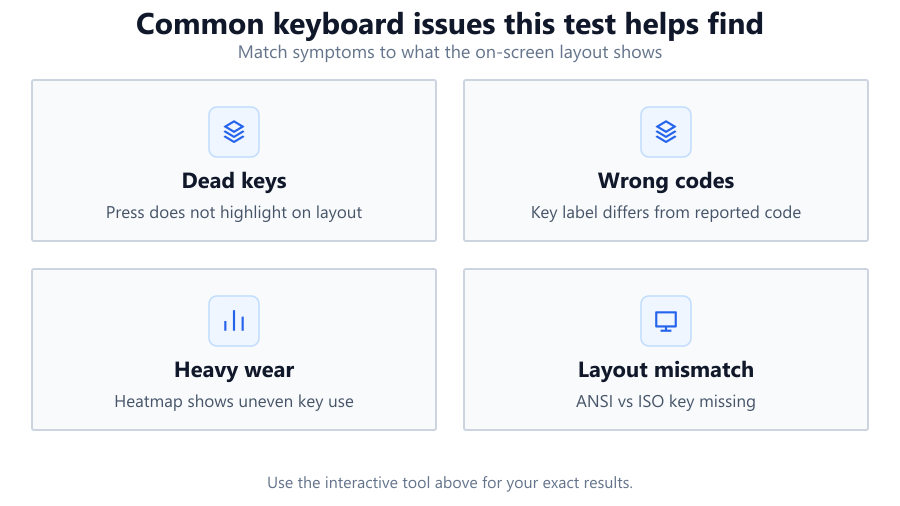
Many users encounter ghosting or missed key presses without realizing it's a hardware limitation. Gamers may find their character stops moving if they press more than three keys at once. Fast typists or musicians using MIDI controllers may notice dropped notes or lost letters. Laptop keyboards, especially on budget models from Dell or HP, often have limited rollover, which this tool can reveal. The test also highlights issues with certain mechanical keyboards, some older or cheaper models lack proper NKRO despite using Cherry MX or similar switches. This tool can also help diagnose problems introduced by USB hubs, KVM switches, or faulty cables, which sometimes block key signals. If you notice inconsistent results, try a different USB port or connect directly to your PC. The tool is also useful for checking if a new gaming keyboard, like the Corsair K70, Logitech G Pro, or Razer BlackWidow, delivers on its advertised anti-ghosting features.
Examples and Scenarios
Scenario 1: Gaming Keyboard Claims Full NKRO You bought a Logitech G Pro keyboard advertised with full NKRO. Using the tool, you press WASD, Shift, Space, and a few number keys simultaneously. Every key lights up, confirming the claim. No ghosting or blocking is present.
Scenario 2: Office Laptop Misses Keys On a Dell Inspiron laptop, you try to hold A, S, D, and Q plus Space. Space doesn't register, and sometimes pressing three keys causes one to drop. The tool shows missing keys, exposing the hardware limitation typical of non-gaming laptops.
Scenario 3: Ghosting on Budget Keyboard A $15 generic USB keyboard shows odd behavior. When holding D and K, the on-screen keyboard shows L as pressed, even though you never touched it. The tool catches this ghosting problem, revealing why typing sometimes outputs wrong letters.
Scenario 4: USB Hub or KVM Switch Interference You connect a Corsair K70 through a USB hub to your PC. When pressing six keys, the tool sometimes misses inputs. Plugging the keyboard directly into the motherboard USB port solves the problem. The test exposes that the hub was limiting simultaneous signals.
Scenario 5: MacOS Accessibility Settings On a MacBook Pro, you notice the tool doesn't register more than two keys at once. After disabling MacOS Keyboard Accessibility options, the tool detects five or more keys as expected. The test helps isolate OS-level input filtering.
Scenario 6: Typist with High-Speed Chording A touch typist uses a mechanical keyboard for fast input. By pressing multiple modifiers and letters at once, they confirm via the tool that all keys are detected, ensuring the hardware won't slow them down during intense typing sessions.
Tips for Accurate Testing
For the most reliable results, use a desktop browser like Chrome, Firefox, or Edge. Avoid running the test inside remote desktop, virtual machines, or over Bluetooth connections, as these may filter or delay key signals. Disable OS-level accessibility features like Sticky Keys, Filter Keys, or similar settings in Windows and MacOS before starting. Make sure no other software is capturing or remapping your keyboard (such as macro programs or gaming overlays). Test common key clusters, WASD, QWER, number row, and modifiers like Shift and Ctrl. If you use a programmable keyboard, reset it to default profiles to rule out custom mappings. For wireless keyboards, ensure batteries are full and the receiver is directly connected to a main USB port. If you suspect hardware issues, repeat the test with another keyboard or on a different machine. Remember, browser-based results give a strong practical indication, but for absolute confirmation, consider using dedicated rollover test software or hardware testers.
Browser vs Desktop Software
Browser-based keyboard testing is fast and convenient, requiring no installation. It's ideal for quick checks and is accurate for most home and office scenarios. However, browsers are subject to OS input handling, security sandboxes, and may not capture every edge case, especially with custom drivers or unusual layouts. Some browsers may block certain key combinations (like Alt+Tab or Ctrl+W) for security reasons. Desktop software, such as AquaKeyTest or Switch Hitter, can often access lower-level input and provide more detailed NKRO analysis. These are better if you need engineering-grade accuracy or are troubleshooting complex devices like programmable gaming keyboards. For most users, the browser test gives a real-world view of how your keyboard performs in actual applications, but if you're a developer or hardware enthusiast, dedicated tools are a worthwhile extra step.
Summary
The Keyboard Ghosting Test is a practical browser tool for checking how your keyboard handles simultaneous key presses, ghosting, and NKRO. It provides instant visual feedback and a simple way to spot hardware or configuration issues. While not as precise as lab equipment, it covers the vast majority of real user needs, including gaming, typing, and productivity. By highlighting recognized and missed keys, this tool helps you decide if you need to upgrade your hardware or adjust your setup. For most users, the browser test is all you need to diagnose common problems, but deeper issues may require dedicated software. Use this tool anytime you want to verify claims from keyboard manufacturers or troubleshoot unexpected input behavior.
Frequently Asked Questions
How do I test for keyboard ghosting in my browser?
To test for ghosting, visit the Keyboard Ghosting Test tool and press multiple keys at the same time. The on-screen keyboard shows every key that your hardware and browser register. If you see extra keys appear that you did not actually press, that's ghosting. If some keys never light up, your keyboard is blocking those key combinations. This method is quick and works in most modern browsers, though results may vary with OS or browser limitations.
What is N-key rollover (NKRO) and why does it matter?
N-key rollover (NKRO) describes how many keys your keyboard can register simultaneously. A true NKRO keyboard can detect every key pressed at once, which is essential for gamers, fast typists, or musicians needing complex input. Most standard keyboards can only handle 2-6 keys at once. Limited rollover can cause missed or dropped keys, especially during fast action or when using shortcuts. Gaming keyboards like the Corsair K70 or Logitech G Pro often advertise high NKRO to prevent these problems.
Why do some keys not register together on my keyboard?
Many keyboards use a matrix wiring design that cannot detect certain key combinations due to hardware limitations. This is especially common on older or budget models. If you try to press three or more keys and one fails to register, it's usually because the keyboard cannot handle that particular combination. Some gaming keyboards solve this by adding extra circuitry or using a different matrix layout, allowing for more simultaneous key presses. The tool helps identify which combinations fail.
Can browser-based tools like this detect all keyboard issues?
Browser-based tests are excellent for practical checks but may miss some advanced issues. Browsers rely on the operating system's keyboard handling, so OS settings, drivers, or browser security may filter certain keys. Some key combinations (like Alt+Tab or Ctrl+W) are intercepted by the OS or browser and won't be detected. For the vast majority of users, browser tests are accurate enough, but if you need engineering-level detail or want to test custom layouts, dedicated desktop software is more precise.
How can I improve my keyboard's rollover or fix ghosting?
If your keyboard suffers from poor rollover or ghosting, hardware is usually the main factor. Try plugging the keyboard directly into your PC, avoiding USB hubs or KVM switches. Update drivers and check for firmware updates from your keyboard manufacturer. If you are using OS-level accessibility features, disable them and retest. For gaming or fast typing, consider upgrading to a keyboard specifically advertised with anti-ghosting or full NKRO support, like the Razer BlackWidow or SteelSeries Apex.
Is the Keyboard Ghosting Test accurate for all devices?
The test is accurate for most standard keyboards and typical use cases. However, browser-based tests have some limitations: they depend on your OS, browser, and even active software that may capture or block certain keys. Results can be affected by remote desktop sessions, virtual machines, or custom firmware. For the most reliable results, use a desktop browser, disable accessibility features, and connect your keyboard directly to your PC. For absolute accuracy, use specialized desktop tools.
Why does my laptop keyboard perform worse than my desktop keyboard?
Laptop keyboards, especially on midrange or budget models from brands like Dell or HP, often have limited rollover due to cost-saving matrix designs. Manufacturers prioritize thinness and battery life over advanced input handling. Desktop mechanical keyboards, like those from Corsair, Logitech, or Razer, usually have better rollover and anti-ghosting because they're designed for gaming or heavy typing. Testing both with the tool will often show your laptop missing keys that a desktop keyboard registers with ease.
Can this tool detect if my keyboard is suitable for gaming?
Yes, the Keyboard Ghosting Test can help determine if your keyboard is suitable for gaming. Try pressing typical gaming key combinations, such as WASD, Shift, Space, and number keys, at the same time. If the tool lights up all the keys you press without missing any, your keyboard should work well for most games. If some keys fail to register, you may experience in-game movement or action issues and should consider a gaming keyboard with higher NKRO.
Does connecting through a USB hub or KVM affect key rollover?
Yes, using a USB hub or KVM switch can sometimes interfere with key rollover. These devices may not transmit all simultaneous signals, leading to missed or blocked key presses. The Keyboard Ghosting Test can help you spot this, if your keyboard works fine when connected directly to your PC but loses inputs through a hub, the hub or KVM is the culprit. Always test direct connections for the best accuracy.
What kinds of keyboards have full NKRO?
Full NKRO is typically found in higher-end mechanical keyboards, especially those marketed towards gamers or professional typists. Models like the Corsair K70 RGB, Logitech G Pro X, and Razer BlackWidow V4 are known for supporting full NKRO. Some membrane keyboards may advertise 'anti-ghosting,' but often only in certain key zones. Always use the test to confirm, since even expensive keyboards can have limitations depending on their matrix design or USB implementation.
Can software or drivers affect my rollover results?
Yes, software and drivers can impact how many simultaneous key presses are detected. Macros, remapping tools, accessibility features, or even third-party keyboard drivers may filter or translate key inputs, reducing actual rollover. OS settings like Sticky Keys in Windows or Keyboard Accessibility in MacOS can also interfere. Before testing, close unneeded programs and check your OS settings to get the most accurate results from the tool.
How do I interpret the NKRO heuristic in this tool?
When you hold six or more keys at once, the tool uses a heuristic to estimate your keyboard's NKRO. If all six or more keys light up without ghosting or blocking, your keyboard likely supports at least 6-key rollover, and possibly full NKRO. If only some keys register or others appear that you did not press, your keyboard has limited rollover or suffers from ghosting. The heuristic is approximate and best used as a general indicator rather than a laboratory measurement.
Why do some key combinations always fail, even on expensive keyboards?
Certain key combinations may be blocked due to the keyboard's internal wiring, regardless of price or advertised features. Even on higher-end models, matrix design flaws or firmware bugs can limit which combinations work. Some keyboards prioritize common gaming clusters for anti-ghosting but neglect others less likely to be used together. Always test the combinations you care about most. If you find repeat failures, consider a different model with proven NKRO in your use case.
Will changing my keyboard layout (like Dvorak or Colemak) affect ghosting?
Changing your keyboard layout in software (like switching to Dvorak or Colemak) does not affect the physical matrix or hardware limitations of your keyboard. Ghosting and blocking are determined by the hardware, not the logical layout. The tool will still show which physical keys are detected, regardless of the mapped character. If you need reliable input for a custom layout, choose a keyboard with proven NKRO and test it with your preferred configuration.
Do wireless keyboards have worse rollover than wired ones?
Wireless keyboards, especially older or budget models, sometimes have lower rollover due to power-saving protocols or limited bandwidth. Many premium wireless gaming keyboards, like the Logitech G915 or Corsair K63 Wireless, have improved this, offering near-wired performance. However, interference, low battery, or poor receiver placement can still affect results. Use the tool to check your wireless keyboard, and for best performance, keep the receiver close and ensure batteries are fresh.
Can I use this tool on a tablet or smartphone?
You can open the tool in a mobile browser, but results will be limited by the on-screen (virtual) keyboard, which typically only supports a single key press at a time. For external Bluetooth keyboards, the test may work, but mobile OSes often filter simultaneous key presses, reducing accuracy. For best results, use a desktop or laptop browser with a physical keyboard connected directly to your device.
Related Tools
Free tools to analyze, compare, and optimize your PC gaming performance
Keyboard Tester
Test every key on your keyboard and verify key responsiveness directly in your browser. Live layout, heatmap, and progre
Use Tool →Keyboard Double Click Test
Detect unwanted double key presses and keyboard chatter with detailed per-key timing analysis.
Use Tool →Keyboard Polling Rate Test
Measure keyboard polling rate, repeat rate in Hz and input responsiveness with live measurements.
Use Tool →Typing Speed Test
Measure your typing speed in WPM, improve accuracy and track your typing performance with multiple test modes.
Use Tool →Popular Game System Requirements
Check if your PC meets the requirements for these popular games
Benchmark data from PassMark and publisher specs. Calculators run locally in your browser — we never upload your hardware info.