
FREE THERMAL THROTTLING CALCULATOR
Thermal Throttling Calculator Estimate Performance Loss
Use this thermal throttling calculator to quickly estimate how much CPU or GPU performance you’re losing due to excessive heat. Find out if your current cooling setup is holding you back, and see how a better cooler could boost your frame rates and system responsiveness.
Throttling Analysis
Enter temperatures, then calculate
What Does This Calculator Do?
The thermal throttling calculator is a technical tool designed to estimate the percentage of performance lost when your processor or graphics card exceeds its thermal throttle point. Thermal throttling is a built-in protection mechanism where a CPU or GPU automatically reduces its clock speed to avoid overheating, directly impacting your system’s speed and responsiveness.
This tool lets you input your component’s junction temperature (the hottest part of the chip), the specific throttle temperature for your model, and the cooling performance (both current and potential upgrades). It then calculates how much performance is being left on the table due to inadequate cooling. The calculator is ideal for enthusiasts, competitive gamers, and PC builders who want to optimize their systems for sustained high performance.
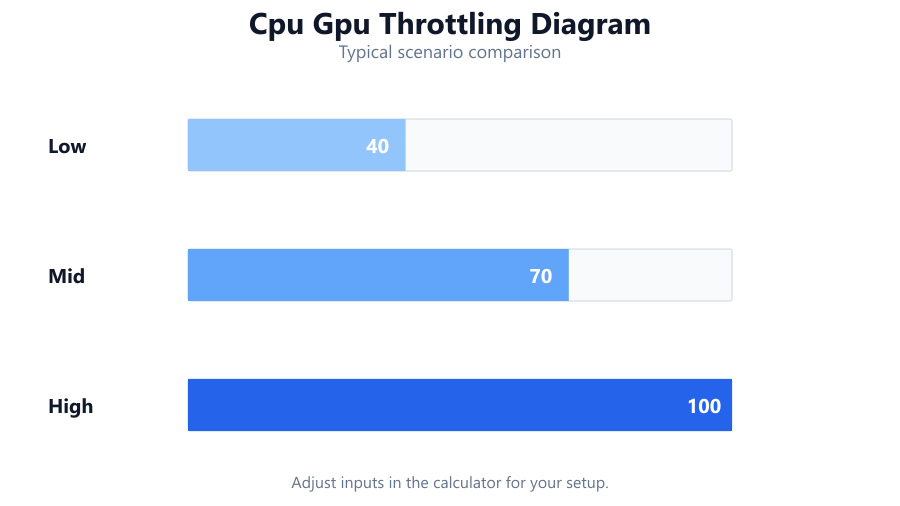
How to Use This Calculator
To get actionable insights, start by identifying the processor or graphics card you want to test. Monitor your component’s actual junction temperature - software like HWMonitor, HWiNFO, or GPU-Z is reliable for this. Next, look up your hardware's official thermal throttle point. For example, many modern NVIDIA GPUs start throttling around 83°C, while high-end AMD CPUs like the Ryzen 7 7800X3D have a throttle point near 95°C.
Enter these values, along with your current cooling solution’s capability (measured as temperature under load). If you’re considering a cooler upgrade, fill in the projected temperature for that scenario as well. The calculator will show both the current performance loss and the potential gain if thermal throttling is reduced or eliminated.
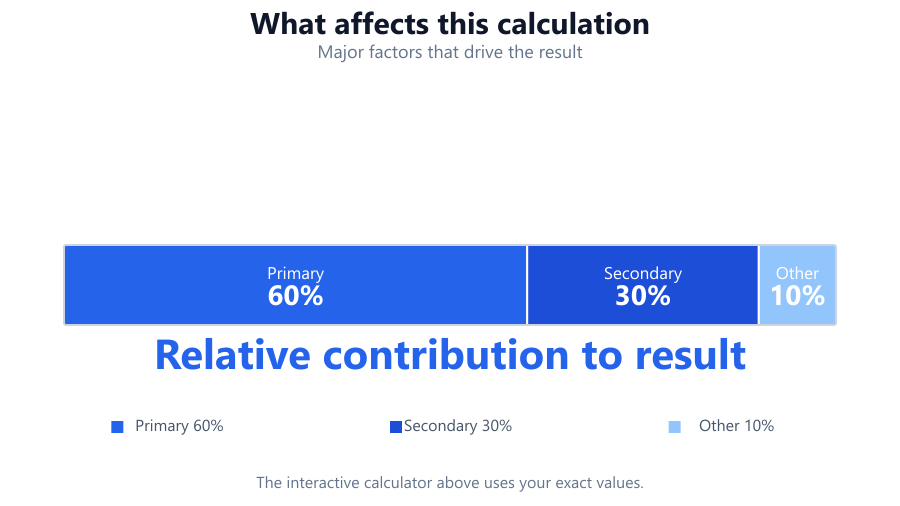
How Are the Results Calculated?
The core logic estimates the percentage of performance lost when your chip operates above its throttle temperature. The formula used is:
Performance Loss (%) = ((Current Junction Temp - Throttle Temp) / (TJmax - Throttle Temp)) × 100, where TJmax is the maximum safe temperature before emergency shutdown (typically 100 - 110°C for CPUs and GPUs).
If your current temperature is below or equal to the throttle point, performance loss is 0%. Once you exceed the throttle temperature, each degree over causes more aggressive clock reductions, increasing total loss. Cooling upgrades reduce the junction temperature, lowering or eliminating the lost performance.
If Throttle Temp is 83°C, Current Temp is 88°C, and TJmax is 100°C
Performance Loss = ((88-83)/(100-83)) × 100 ≈ 29.4% Assumptions:
- Detail 1
- The relationship between temperature and throttling is linear (for estimation; actual throttling can be stepwise or non-linear).
- Detail 2
- Actual performance impact can vary by workload and architecture.
- Detail 3
- The calculator is best used as a guideline, not a replacement for real-world benchmarking.
Understanding Your Results
The output shows the estimated percentage of performance your CPU or GPU is losing due to thermal throttling. This figure represents how much slower your component is running compared to its theoretical maximum.
A small loss (up to 5%) is usually tolerable and unlikely to be noticed in daily tasks, but higher figures (10 - 30% or more) indicate a significant bottleneck. In gaming, that could mean the difference between smooth, consistent frame rates and stutters or slowdowns. In workstation scenarios, it could lengthen render or compile times.
If you enter an upgraded cooling solution and see the performance loss drop to 0%, your system will be able to run at full speed under sustained load. If some loss remains, consider even better cooling or improved case airflow.
Examples
Gaming PC with RTX 4070
- Throttle Temp
- 83°C
- Current Junction Temp
- 88°C
- TJmax
- 100°C
- Performance Loss
- ((88-83)/(100-83)) × 100 ≈ 29.4%
- Upgrade to
- No throttling, 0% loss
Ryzen 7 7800X3D Workstation
- Throttle Temp
- 95°C
- Current Temp
- 97°C
- TJmax
- 110°C
- Performance Loss
- ((97-95)/(110-95)) × 100 ≈ 13.3%
- Cooler upgrade to 90°C
- 0% loss
Laptop with RTX 3060 Mobile
- Throttle Temp
- 87°C
- Current Temp
- 92°C
- TJmax
- 100°C
- Performance Loss
- ((92-87)/(100-87)) × 100 ≈ 38.5%
- Undervolting or repasting drops temp to 85°C
- 0% loss
Overclocked Intel Core i9-13900K
- Throttle Temp
- 100°C
- Current Temp
- 102°C
- TJmax
- 110°C
- Performance Loss
- ((102-100)/(110-100)) × 100 ≈ 20%
- Adding a custom loop brings temp to 94°C
- 0% loss
Budget Build with Radeon RX 6600
- Throttle Temp
- 90°C
- Current Temp
- 89°C
- TJmax
- 110°C
- Performance Loss
- 0% (No throttling)
Server with Xeon Silver 4310
- Throttle Temp
- 85°C
- Current Temp
- 90°C
- TJmax
- 105°C
- Performance Loss
- ((90-85)/(105-85)) × 100 ≈ 25%
Common Use Cases
- Gamers chasing stable frame rates in hot environments.
- Content creators who notice slower video rendering or compiling during long sessions.
- Small form factor (SFF) PC builders where airflow is restricted.
- Laptop users looking to maximize performance through undervolting or repasting.
- Overclockers who want to quantify the impact of extra heat.
- Data center admins ensuring servers don’t experience hidden slowdowns in a rack.
This calculator is also valuable when considering hardware upgrades, helping you choose between investing in a better cooler or a more powerful component.
Tips for Better Results
- Always use accurate, real-world temperature measurements under sustained load (not idle or short bursts).
- Check your hardware’s official thermal throttle and TJmax values from manufacturer documentation.
- Consider ambient room temperature - higher room temps can push your system over the edge.
- Factor in dust buildup, case airflow, and thermal paste age for more realistic simulations.
- Test with multiple workloads (gaming, rendering, stress tests) for a broader picture.
- If your hardware uses aggressive fan curves, you may see temperatures fluctuate rapidly - average the temps over 10 - 15 minutes for more stable results.
- For laptops or SFF PCs, minor improvements in cooling can yield disproportionately large performance gains.
Conclusion
Thermal throttling is a silent performance killer that often goes unnoticed until you start measuring its effects. With the thermal throttling calculator, you gain a clear, data-driven estimate of how much speed you’re losing and what you could gain from better cooling. Whether you’re a gamer, a creator, or a professional, understanding and addressing thermal limits is key to unlocking your hardware’s full potential.
Remember that this tool provides estimates based on typical throttling behavior and linear models. For the most accurate assessment, combine calculator output with real-world stress tests and monitoring. A modest investment in cooling can often yield outsized gains, particularly in high-performance or compact systems.
Frequently Asked Questions
What is thermal throttling?
Thermal throttling is a safety mechanism built into CPUs and GPUs that reduces their clock speeds when a specific temperature threshold is exceeded. This prevents permanent hardware damage by lowering power draw and heat output, but it also decreases performance. The effect is most noticeable during sustained heavy workloads, such as gaming or rendering, where the component cannot cool down quickly enough.
How does the thermal throttling calculator estimate performance loss?
The calculator uses your component’s current junction temperature, the manufacturer’s throttle temperature, and the maximum safe temperature (TJmax) to estimate how much performance is lost. It assumes a linear reduction in performance for every degree above the throttle point, which matches typical throttling behavior in most CPUs and GPUs. Actual throttling may be non-linear or workload-dependent, so the output is an approximation.
What information do I need to use this calculator?
You need your component’s current junction temperature under load, the official throttle temperature for your CPU or GPU, and optionally the maximum safe temperature (TJmax). You can find these values in manufacturer datasheets or by monitoring your hardware with tools like HWMonitor, HWiNFO, or GPU-Z. For simulating upgrades, estimate the expected temperature after installing a new cooler.
What is the difference between junction temperature and core temperature?
Junction temperature refers to the hottest spot on the silicon die, often labeled as "Tjunction" or "Hotspot" in monitoring software. Core temperature is the average or per-core reading, which can be several degrees lower than the junction. For throttling, the junction temperature is the most critical value, as it triggers the throttle mechanism.
How accurate are the performance loss estimates?
The estimates are based on a simplified, linear model and typical manufacturer throttle behaviors. Real hardware may throttle in steps or respond differently depending on workload and power limits. Consider these results as a guideline rather than an exact measurement; for precise tuning, combine calculator results with actual benchmarking.
What is TJmax?
TJmax (junction maximum) is the highest safe operating temperature for a CPU or GPU die. If this value is exceeded, the component will either throttle extremely or shut down to avoid damage. TJmax varies by model and manufacturer, but is typically between 95°C and 110°C for modern CPUs and GPUs.
Can improving my cooling eliminate all performance loss?
If your cooling solution brings the junction temperature below the throttle point, you will eliminate thermal throttling and regain full performance. In some cases, further cooling won’t improve performance if you’re already below the throttle temperature. Focus on maintaining safe, sustained temperatures under full load for best results.
Does throttling behave the same on all CPUs and GPUs?
No, throttling behavior varies by architecture, manufacturer, and even specific model. Some chips throttle gradually, while others use abrupt steps. Laptops and compact devices often throttle earlier and more aggressively due to limited cooling. Always refer to official documentation for your hardware’s exact behavior.
How do I find my CPU or GPU’s throttle temperature?
Check the official datasheets or product pages from Intel, AMD, or NVIDIA for your specific model. Many enthusiast forums and review sites (like Tom’s Hardware or AnandTech) also publish throttle points for popular CPUs and GPUs. Monitoring software may display the current throttle threshold as well.
Can undervolting reduce thermal throttling?
Yes. Undervolting reduces the voltage supplied to your CPU or GPU, decreasing heat output without sacrificing performance. This can lower junction temperatures and, if done properly, eliminate or reduce throttling. Undervolting is especially effective in laptops and SFF PCs where cooling is limited.
Should I be concerned if my system only throttles during stress tests?
Not necessarily. Stress tests are designed to push hardware to its limits and may not reflect real-world workloads. If you only see thermal throttling during synthetic benchmarks and not during typical use (gaming, rendering, etc.), your cooling is likely adequate for practical purposes.
What are the most effective ways to reduce thermal throttling?
The most effective methods include upgrading your CPU/GPU cooler, improving case airflow, reapplying high-quality thermal paste, cleaning out dust, optimizing fan curves, and undervolting where possible. For laptops, repasting and using cooling pads can also help. Each step can lower junction temperatures and reduce or eliminate throttling.
Does overclocking increase the risk of thermal throttling?
Yes. Overclocking raises power consumption and heat output, making it more likely your hardware will reach or exceed its throttle point. High-performance cooling is critical for stable overclocks; otherwise, you may see lower performance than stock settings due to excessive throttling.
How can I tell if I’m losing performance to thermal throttling in games?
Monitor your CPU and GPU temperatures while gaming. If readings exceed the throttle temperature and you observe sudden drops in clock speeds (visible in tools like MSI Afterburner or HWiNFO), you are likely experiencing thermal throttling. Symptoms include sudden FPS drops, stutters, or inconsistent performance during prolonged sessions.
Is some degree of thermal throttling normal in laptops?
Yes, especially in thin-and-light laptops with limited cooling capacity. Many modern laptops are designed to briefly exceed throttle points, then reduce clocks to maintain safe operation. The key is to minimize sustained throttling as much as possible, especially during demanding workloads.
How often should I check for thermal throttling?
Check after significant changes - like installing new hardware, upgrading your cooler, or changing your system’s location. It’s a good practice to monitor temperatures every few months, or if you notice unexplained slowdowns or performance drops.
Can thermal throttling damage my hardware?
No, thermal throttling is a protective feature that prevents damage by reducing heat output. However, running at high temperatures for extended periods can degrade thermal paste and, in rare cases, shorten component lifespan. Consistent, moderate temperatures are best for longevity.
Why does my hardware throttle even with a high-end cooler?
Several factors can cause this: poor thermal paste application, high ambient temperatures, inadequate case airflow, or manufacturing defects. Even top-tier coolers can't compensate for poor case design or environmental heat. Always verify installation and ensure your entire cooling ecosystem is optimized.
Related Tools
Free tools to analyze, compare, and optimize your PC gaming performance
Popular Game System Requirements
Check if your PC meets the requirements for these popular games
Benchmark data from PassMark and publisher specs. Calculators run locally in your browser — we never upload your hardware info.