GTX 1650 (G3D Mark: 7,350) → RTX 4060 (G3D Mark: 17,500)
- Gain
- (17,500 / 7,350 - 1) × 100 ≈ 138.1% FPS increase

FREE GPU UPGRADE CALCULATOR
Quickly estimate the real-world performance boost you can expect from a graphics card upgrade. This tool compares your current GPU with your target upgrade, projecting average FPS gains, power usage changes, and value metrics based on trusted benchmark data.
Enter GPU marks, then calculate
The GPU upgrade calculator is designed to help you make informed decisions about upgrading your graphics card. By comparing the PassMark G3D Mark scores of your existing GPU and a potential upgrade, it estimates the percentage increase in 3D performance and projects expected frames-per-second (FPS) improvements in typical gaming scenarios.
It also provides additional data such as power consumption differences, value-for-money analysis, and potential system bottlenecks. The calculator leverages an extensive database of GPU benchmarks to deliver estimates based on industry-standard metrics.
Whether you're a gamer, content creator, or enthusiast, this tool provides quick, data-driven insights into what you can expect from a GPU upgrade - before you commit to a purchase.
Using the GPU upgrade calculator is straightforward:
The tool will instantly display estimated FPS gain percentages, side-by-side performance metrics, power requirements, and value scores. For advanced users, you can also factor in your CPU model to account for potential bottlenecks.
If you’re unsure of your exact GPU model, check your system information or use third-party utilities like GPU-Z.
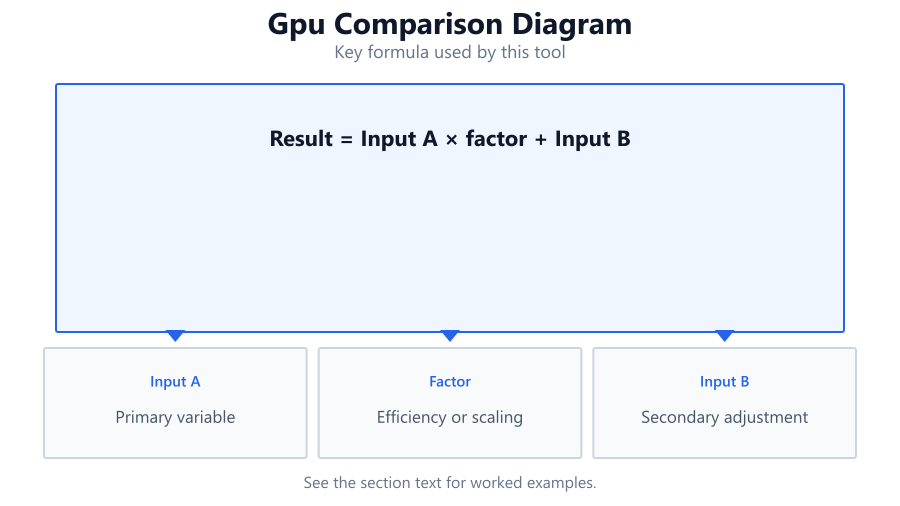
The core metric used by the GPU upgrade calculator is the PassMark G3D Mark score, a widely recognized synthetic benchmark that reflects overall 3D graphics performance. The estimated FPS gain percentage is calculated using the following formula:
FPS gain % ≈ (UpgradeMark / CurrentMark - 1) × 100
Where:
For example, if your current GPU scores 8,000 and your target upgrade scores 16,000: FPS gain % ≈ (16,000 / 8,000 - 1) × 100 = (2 - 1) × 100 = 100%
Other metrics, such as power consumption, are derived from manufacturer TDP (Thermal Design Power) specifications. Value-for-money is calculated as G3D Mark per USD, based on current market pricing.
It's important to note that while PassMark scores provide a robust baseline, real-world FPS improvements may vary depending on game engine optimization, CPU bottlenecks, driver support, and system configuration. The calculator assumes similar system conditions and graphics settings for both GPUs.
The calculator provides several key outputs:
For example, upgrading from an NVIDIA GTX 1060 (G3D Mark ~8,900) to an RTX 4060 (G3D Mark ~17,500) is an estimated 96.6% performance gain. However, if paired with a lower-end CPU, actual game FPS gains may be less pronounced, especially at lower resolutions.
Always interpret the results as estimates, not guarantees. Use them as a foundation for deeper research and to shortlist viable GPU upgrades.
Here are several realistic upgrade scenarios, including performance gain calculations:
These examples show how performance gains scale with different upgrade paths. Note that diminishing returns are common at the high end, while older GPUs often see dramatic improvements with a modern card.
The GPU upgrade calculator is valuable for a variety of scenarios:
Example: A competitive esports player upgrading from a GTX 1660 Super to an RTX 4060 will see significant FPS increases in games like Valorant and Apex Legends, often doubling performance at 1080p and enabling higher refresh rate monitors to be fully utilized.
To get the most accurate and useful estimates from this calculator:
The calculator uses PassMark G3D Mark scores to provide a consistent, hardware-agnostic baseline for comparing GPU performance. While this approach is reliable for general projections, real-world FPS gains may vary depending on the games you play, your CPU, system memory, and in-game settings. For most users, the tool offers a realistic estimate, but it should be supplemented with game-specific benchmarks where possible.
The PassMark G3D Mark is a synthetic benchmark score that evaluates overall 3D graphics performance across a wide range of workloads. It's widely referenced in the industry for cross-GPU comparisons because it provides a standardized, vendor-neutral metric. The calculator leverages these scores for consistent, apples-to-apples comparisons between different graphics cards.
By default, the calculator assumes your CPU is not a limiting factor. However, you can input your CPU model for a more nuanced analysis, allowing the tool to flag potential bottlenecks. High-end GPUs paired with entry-level or older CPUs may not reach their full potential, especially at lower resolutions or in CPU-heavy games.
Not always. The calculated percentage is an average estimate based on synthetic benchmarks. In practice, actual FPS gains depend on your specific games, graphics settings, CPU, and system memory. Some games are more CPU-bound, while others scale almost linearly with GPU performance. The calculator provides a solid baseline, but actual results can vary.
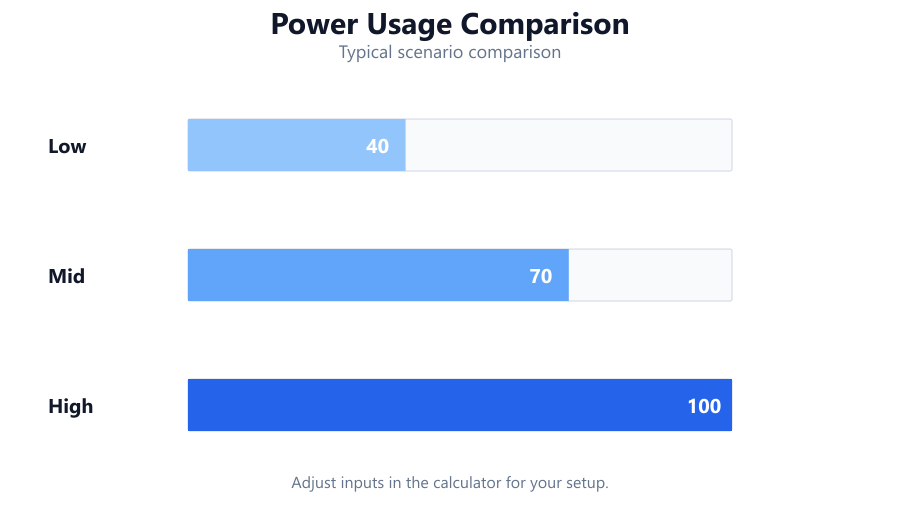
Upgrading to a more powerful GPU often increases power consumption (TDP). The calculator highlights the difference in power draw between your old and new card, helping you assess whether your current PSU can handle the change. Always verify your power supply's wattage and connectors before installing a new GPU.
While the core calculation focuses on overall GPU performance, the tool displays VRAM capacities for both GPUs. This is important for modern gaming at 1440p, 4K, or with high-resolution texture packs. Insufficient VRAM can lead to stuttering or reduced image quality, so always consider your typical workloads.
The calculator is primarily intended for gaming and general 3D workloads. For specialized applications like CAD, 3D rendering, or machine learning, real-world performance may differ significantly from G3D Mark projections. For those cases, consult application-specific benchmarks or consider workstation-class GPUs.
Most laptops do not support GPU upgrades, as their graphics chips are typically soldered onto the motherboard. This tool is intended for desktop GPUs, though you can use it to compare mobile GPU performance if you're shopping for a new laptop.
On Windows, right-click the desktop and open 'Display settings' > 'Advanced display settings' or run 'dxdiag' from the Start menu. Utilities like GPU-Z or Speccy can also provide detailed GPU information. On macOS or Linux, check system information utilities or use terminal commands such as 'lspci.'
The calculator relies on a comprehensive but finite database of GPUs. If your exact model isn't listed, try selecting the closest match by series and performance tier. If in doubt, consult the manufacturer's specifications or PassMark's database for approximate G3D Mark scores.
The calculator is designed for single-GPU comparisons. Multi-GPU configurations are less common today and often provide inconsistent scaling in modern games. If you're using SLI or CrossFire, estimate combined performance using synthetic benchmarks, but be aware that real-world scaling is rarely linear.
Value-for-money is calculated by dividing the PassMark G3D Mark score by the current market price of the GPU (G3D Mark per USD). This helps you see which GPU offers the best performance for your budget, though availability and pricing can fluctuate significantly over time.
This calculator does not generate personalized GPU recommendations, but it allows you to compare any two cards and analyze cost-effectiveness. For tailored advice, use our PC Upgrade Advisor:
Check your PSU's wattage rating (printed on the unit) and compare it to the recommended wattage for your new GPU, factoring in the rest of your components. The calculator shows TDP differences, but always consult the GPU manufacturer's official PSU recommendations before upgrading.
A newer GPU often improves video encoding, decoding, and real-time effects acceleration, especially in software like Adobe Premiere Pro, DaVinci Resolve, or OBS. However, CPU, RAM, and storage speed can also impact these tasks. For streaming, hardware encoders (NVENC, AMD VCE) on modern GPUs offer significant benefits.
The main limitations are:
The GPU database is updated regularly to reflect new releases, revised PassMark G3D Mark scores, and changes in market pricing. For the most accurate comparisons, always check for the latest updates and consult recent reviews of new graphics cards.
Yes, integrated GPUs (such as Intel UHD, Iris Xe, or AMD Radeon Vega) are included in the database. The calculator will show the expected performance uplift when moving from integrated graphics to a dedicated card, which is often dramatic for gaming and creative workloads.
Free tools to analyze, compare, and optimize your PC gaming performance
Check if your PC meets the requirements for these popular games
Benchmark data from PassMark and publisher specs. Calculators run locally in your browser — we never upload your hardware info.