For example, if your refresh rate is 60Hz
Frame Time = 1000 / 60 = 16.67 milliseconds.

FREE REFRESH RATE CALCULATOR
Find out exactly how long each frame is displayed on your monitor by entering any refresh rate. This refresh rate calculator instantly converts Hertz (Hz) into frame time in milliseconds, so you can compare monitors or fine-tune your gaming setup with hard numbers.
13.33 ms frame time
This refresh rate calculator helps you determine how much time each frame stays on your screen at a given refresh rate. Enter any value in Hertz, and the tool outputs the frame time in milliseconds. This is essential for comparing displays, troubleshooting motion blur, or understanding the impact of switching between 60Hz, 144Hz, or even 360Hz monitors.
It’s especially useful if you want to know the real-world difference between common refresh rates like 60Hz versus 120Hz, or to see how a high-refresh display changes the feel of fast-paced games. The calculator also helps demystify what these numbers mean, showing how refresh rate affects motion clarity and responsiveness.
Using the refresh rate calculator is straightforward. Enter your monitor’s refresh rate in Hertz into the input field. The calculator will instantly display the corresponding frame time in milliseconds. For example, typing 144 gives you the exact duration each frame is visible at 144Hz.
You can compare multiple common refresh rates, like 60Hz, 120Hz, 144Hz, 240Hz, and 360Hz, to see how frame time drops as refresh rate increases. This is handy for gamers, video editors, or anyone curious about their display’s temporal performance.
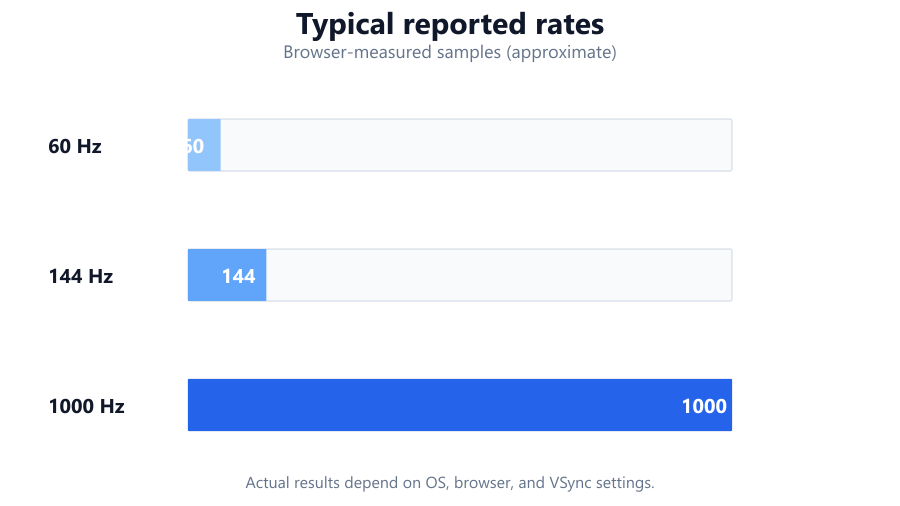
The calculation is based on a simple formula: Frame Time (ms) = 1000 / Refresh Rate (Hz).
Frame Time = 1000 / 60 = 16.67 milliseconds.
Frame Time = 1000 / 144 = 6.94 milliseconds. This means each frame is displayed for a shorter period as refresh rate increases, giving you smoother motion and lower input latency. The calculator uses this formula for any refresh rate you enter, so you can see how even small changes impact frame delivery.
Interpreting the calculator’s output is key. A lower frame time means your display is refreshing more often, which translates to smoother animations and less motion blur. For instance, 60Hz results in a frame time of 16.67ms, while 144Hz cuts that to just 6.94ms per frame.
Gamers and competitive players benefit from higher refresh rates because actions appear on screen sooner. For general desktop use, higher refresh rates make mouse movement and scrolling feel more responsive. However, your GPU must also deliver frames fast enough to take advantage of a high-refresh monitor. If you’re using a GeForce RTX 4070 or Radeon RX 7800 XT, you’ll see the biggest benefit at 144Hz and up.
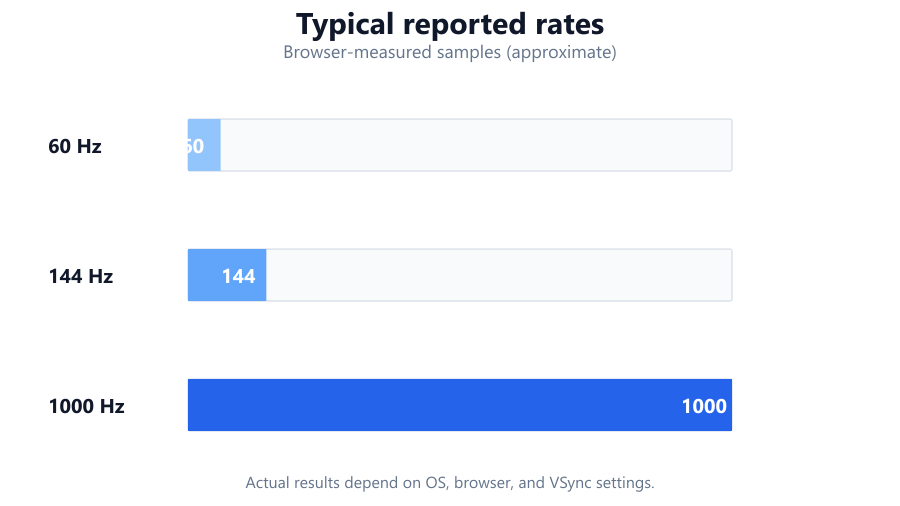
A typical office monitor runs at 60Hz. Entering 60 gives a frame time of 16.67ms. This is fine for browsing and productivity, but not ideal for fast action games.
A midrange gaming monitor like the ASUS VG27AQ is set to 144Hz. The calculator outputs 6.94ms per frame. Movements look smoother, and input lag drops compared to 60Hz.
A BenQ Zowie XL2546K at 240Hz delivers a frame every 4.17ms. This is preferred by pro FPS players where every millisecond matters.
The Alienware AW2524H runs at 360Hz, yielding a frame time of just 2.78ms. This is the current ceiling for consumer LCD monitors.
If you use a custom setting, say 75Hz, the calculator returns 13.33ms per frame. This is a modest improvement over 60Hz, often found on budget IPS panels.
Modern consoles like PlayStation 5 and Xbox Series X support 120Hz. Entering 120 shows a frame time of 8.33ms, giving a clear advantage over 60Hz modes.
Gamers: Use the refresh rate calculator to see how a new 144Hz or 240Hz monitor will cut input latency and motion blur compared to 60Hz. Competitive titles like Valorant or CS2 benefit most.
Content Creators: Video editors working at 120Hz or 144Hz can check frame times to match playback with footage shot at high frame rates. This prevents stutter and mismatches between source and display.
PC Builders: When speccing a system with hardware like a Ryzen 7 7800X3D and RTX 4070, confirm your GPU can push enough frames to justify a 240Hz or 360Hz panel.
General Users: Use the calculator to confirm if a 75Hz or 120Hz monitor is worth the price premium over 60Hz for your workflow or gaming needs.
Monitor Overclocking: If you’re trying a nonstandard refresh rate like 165Hz, the calculator instantly shows the new frame time, letting you gauge the real impact of your tweak.
Know your GPU limits: A high refresh rate is only useful if your graphics card can deliver matching frame rates. An RTX 3060 might struggle to feed a 240Hz display in modern AAA games.
Beware of marketing specs: Some monitors advertise high refresh rates but only achieve them with overclocking or in specific modes. Always check native refresh support.
Understand input lag: Lower frame times can reduce perceived input lag, but end-to-end latency depends on your entire system, including USB polling rate, display processing, and OS overhead.
Panel type matters: IPS, VA, and TN panels respond differently at high refresh rates. Fast TN panels can hit 240Hz or 360Hz, but IPS panels often max out at 144Hz or 165Hz.
Check your cables: Not all HDMI or DisplayPort versions support high refresh rates at high resolutions. For 144Hz at 1440p or 240Hz at 1080p, use DisplayPort 1.2 or HDMI 2.0 and above.
The refresh rate calculator is a quick way to translate Hertz into frame time, making it easier to compare monitors or justify an upgrade. By understanding the relationship between refresh rate and frame time, you can make more informed decisions about display purchases or system tuning.
Whether you’re a competitive gamer chasing every millisecond or a content creator editing high frame rate footage, this calculator gives you a concrete measurement to work with. Always consider both your display and PC hardware capabilities before making changes. For the most accurate results, check your monitor’s actual supported refresh rates and make sure your GPU can keep up.
Enter your monitor's refresh rate in Hertz into the calculator. It will display the frame time in milliseconds, showing how long each image stays on screen before the next one appears. This helps you compare different monitors, check the benefits of upgrading, or troubleshoot display issues.
Frame time is the duration each frame is visible on your display, measured in milliseconds. Lower frame times mean the screen updates more often, reducing motion blur and input lag. In fast-paced games like Apex Legends, a lower frame time from a 144Hz or 240Hz monitor makes gameplay feel smoother and more responsive.
Yes, the difference is significant for gaming and general use. 60Hz means each frame lasts roughly 16.67ms, while 144Hz cuts that to 6.94ms. Mouse movement, scrolling, and fast action all look much smoother at 144Hz, especially when your GPU can deliver high frame rates.
It depends on your GPU and CPU. For example, an RTX 4070 and Ryzen 7 7800X3D can drive 144Hz or even 240Hz in many games at 1080p or 1440p. Older or entry-level GPUs, like a GTX 1650, may struggle to consistently deliver high frame rates required for 144Hz or above.
You can check your monitor’s refresh rate in your operating system’s display settings or your GPU’s control panel (NVIDIA Control Panel or AMD Radeon Settings). Some monitors also display the current refresh rate in their on-screen display (OSD) menus.
Most competitive gamers prefer 144Hz or higher. 240Hz and 360Hz monitors offer even lower frame times, but the improvement beyond 144Hz is more subtle and mostly benefits esports players in fast FPS titles. The best refresh rate is also limited by your system’s ability to deliver matching frame rates.
This usually means the correct display driver is not installed, or you’re using a cable that doesn’t support high refresh rates. Try updating your GPU drivers and use a certified DisplayPort or HDMI cable. Also, set the refresh rate manually in Windows Display Settings.
Yes, higher refresh rates reduce the time between your input and what you see on screen. For example, 144Hz displays update nearly twice as fast as 60Hz, making controls feel more immediate. However, total input lag also depends on your system, not just the monitor.
The jump from 60Hz to 75Hz is modest (16.67ms vs 13.33ms per frame), but upgrading to 120Hz (8.33ms) offers a much more noticeable improvement. If your budget and hardware allow, 120Hz or 144Hz is recommended for both gaming and general use.
Higher refresh rates can reduce eye strain, especially during long sessions. Smoother scrolling and less flicker at 120Hz or 144Hz are easier on the eyes compared to 60Hz, particularly for users sensitive to flickering or those working with fast-moving content.
Not always. Most movies and TV shows are filmed at 24 or 30 FPS. However, higher refresh rates can improve smoothness in high frame rate content, like 60 FPS YouTube videos or games. Some displays use frame interpolation for smoother playback, but this can introduce artifacts.
If your GPU outputs fewer frames than your monitor’s refresh rate, you won’t see the full benefit of a high-refresh panel. Technologies like G-Sync or FreeSync can help by matching the display’s refresh rate to your GPU’s frame output, reducing stutter and tearing.
360Hz monitors deliver extremely low frame times (2.78ms), but the difference from 240Hz or even 144Hz is subtle for most users. Competitive esports players may benefit, but casual gamers and general users usually see diminishing returns past 144Hz or 240Hz.
Refresh rate itself doesn’t impact color or brightness. However, some high-refresh panels may compromise slightly on color accuracy or backlight uniformity compared to slower, more color-focused monitors. Always check reviews for panel quality, not just speed.
To achieve high refresh rates at high resolutions, use the right cable. DisplayPort 1.2 or higher and HDMI 2.0/2.1 support 144Hz at 1440p and 240Hz at 1080p. Older HDMI versions may limit you to 60Hz, even if your monitor and GPU support more.
Refresh rate (Hz) is how often your monitor updates per second, while FPS (frames per second) is how many frames your GPU produces. For the smoothest visuals, FPS should match or exceed your monitor’s refresh rate. If the FPS is lower, you won’t fully benefit from a high-refresh display.
Free tools to analyze, compare, and optimize your PC gaming performance
Find the best gaming monitor for your GPU
Use Tool →Estimate your gaming frame rate based on your hardware
Use Tool →Estimate FPS after upgrading CPU or GPU
Use Tool →Estimate gaming performance gains from a GPU upgrade
Use Tool →Check if your PC meets the requirements for these popular games
Benchmark data from PassMark and publisher specs. Calculators run locally in your browser — we never upload your hardware info.